
 604-694-0015

Above or Below the Muscle: Subglandular vs. Submuscular Breast Implant Positioning
September 3, 2026
Back To Blog
Two patients can choose the same implant and end up with very different results, because the implant does not sit in the same place. Subglandular placement puts it above the pectoral muscle; submuscular placement puts it behind. That one decision shapes how the upper breast slopes, how the implant edge reads under thin tissue, and how the chest behaves when you train it. What follows is what actually separates the two, in the terms your surgeon will use in the room, so you walk into a breast augmentation in Vancouver consultation with real questions rather than a list of adjectives.
What Is Breast Implant Positioning and Why Does It Matter?
Breast implant positioning describes where, anatomically, the implant is placed in relation to the pectoral muscle and breast tissue. The two primary techniques are subglandular placement, in which the implant sits above the pectoral muscle and behind the breast gland, and submuscular placement, in which the implant is positioned behind the pectoral muscle itself. A third variation, the dual-plane technique, partially positions the implant behind the muscle while allowing the lower pole to interact directly with the breast gland, and it is often considered a refinement of the submuscular approach.
The distinction matters because each position affects several outcomes that patients genuinely care about:
Natural Contour and Aesthetic Appearance
Subglandular placement tends to produce more visible upper pole projection and a rounder silhouette, which some patients prefer. Submuscular placement, by contrast, typically allows the overlying muscle to soften the implant’s upper edge, often yielding a more gradually sloped transition that can look closer to a naturally shaped breast, particularly in patients with less native tissue coverage.
Tissue Coverage and Long-Term Integrity
Patients with thinner breast tissue may benefit from the additional coverage that the pectoral muscle provides in a submuscular position, as it can reduce the likelihood of visible implant edges or rippling. Patients with enough native tissue to cover the implant, and those who would rather avoid work around the pectoral muscle, may be better suited to the subglandular approach. Reviewing before and after breast surgery results can help patients develop realistic visual expectations before their consultation.
Recovery and Activity Considerations
Because submuscular placement involves releasing and working around the pectoral muscle, the initial recovery period may differ from the subglandular approach, where the muscle remains entirely undisturbed. Patients with physically active lifestyles or those who train the chest regularly should discuss how each placement may interact with their activity goals over time.
Comparing Breast Implant Positioning: Subglandular vs. Submuscular Placement
When weighing breast implant positioning, subglandular and submuscular techniques each carry a distinct set of considerations. Neither is universally superior, and the right choice depends on your anatomy, aesthetic preferences, and lifestyle. In a surgical consultation, your provider will assess your current tissue envelope, chest wall anatomy, and the implant profile you are considering before making a recommendation.
Subglandular Placement: Key Considerations
Subglandular positioning places the implant directly behind the breast gland, leaving the pectoral muscle intact. This approach is associated with a shorter operative time and, for many patients, a more straightforward recovery trajectory. It can be particularly appropriate for patients who already have a moderate amount of breast tissue and are seeking fuller projection in the upper pole. One consideration to discuss with your surgeon is capsular contracture, a process in which scar tissue around the implant tightens over time; the risk profile differs somewhat between subglandular and submuscular placement, and Dr. Tregaskiss will explain how it applies to your plan.
Submuscular Placement: Key Considerations
Submuscular positioning provides the pectoral muscle as an additional layer between the implant and the skin. This can be particularly valuable for patients with limited native tissue, as the muscle helps to soften edges and support a more natural transition at the upper breast border. The dual-plane variation allows surgeons to tailor the degree of muscle coverage with precision. Patients who use VECTRA 3D imaging during planning often arrive at the placement discussion with a clearer sense of the look they are after, which makes the conversation more productive.
Both approaches can be performed with saline or silicone implants, and the implant shape, profile, and size are all separate variables that interact with the chosen positioning technique. Thorough anatomical assessment is essential before any decision is made.
Choosing the Right Breast Implant Position: What the Consultation Process Looks Like
The consultation is where breast implant positioning decisions move from general education to personalized surgical planning. A thorough evaluation includes a physical assessment of your current breast dimensions, chest width, skin laxity, and the thickness of your existing tissue layer. These measurements, combined with your aesthetic goals and lifestyle, give your surgeon the information needed to recommend the most appropriate technique.
Questions Worth Asking at Your Consultation
Patients who come prepared with specific questions tend to leave consultations with far greater clarity. Consider asking your surgeon to explain how your tissue thickness influences the recommendation, what the expected healing timeline looks like for each approach, and whether your activity level or body composition might favor one technique over another. You might also ask to see examples from the practice’s plastic surgery before and after photo gallery that reflect anatomy and goals similar to your own.
Planning the Decision Before You Travel
Pacific Plastic Surgery offers both in-person and virtual consultations, so patients across the Vancouver area, including Langley, Surrey, and Burnaby, can begin planning before travelling to the office. Patients coming from further afield can review the practice out-of-town patient information first. For patients who are still in the research phase, the Pacific Plastic Surgery blog offers additional resources on breast surgery topics and what to expect throughout the process. Additional general information is also available through the general questions page on the practice website.
Outcomes differ from patient to patient, because anatomy, implant choice, surgical technique and healing all feed into the final result.
Who Performs the Surgery, and Why It Changes the Plan
Dr. Ashley Tregaskiss is a board-certified plastic surgeon in Vancouver with over 20 years of experience and a focus on advanced facial and neck rejuvenation. After a decade at Vancouver General Hospital treating complex craniofacial and head and neck conditions, he transitioned fully into private practice in 2024, bringing exceptional anatomical expertise and surgical precision to his aesthetic work.
That anatomical grounding shapes every cosmetic procedure he performs, including breast augmentation, where an accurate read of tissue quality and chest wall anatomy drives the placement decision. Learn more on the Meet Dr. Ashley Tregaskiss page. Pacific Plastic Surgery holds five-star ratings on both Google and RateMDs and serves patients throughout the greater Vancouver region.
What Patients Ask Before Choosing a Placement
Is subglandular or submuscular placement better for a more natural look?
Neither technique is universally superior for natural appearance; the better result depends on your anatomy. Patients with limited breast tissue often benefit from submuscular placement, where the muscle softens the implant edge for a more gradual contour. Patients with more native tissue may achieve equally natural results with subglandular positioning. A physical assessment with Dr. Tregaskiss will help determine which approach suits your anatomy and aesthetic goals.
Can breast implant position be changed after the original surgery?
Yes, it is possible to change implant positioning during a revision procedure. Patients who experience concerns related to their initial placement, whether aesthetic or anatomical, may explore revision options during a consultation. Dr. Tregaskiss’s extensive anatomical background, developed through years of complex reconstructive work, informs his approach to both primary and revision breast surgery. Discussing your history and current concerns openly during your consultation will help clarify whether revision is appropriate for your situation.
Does the choice of implant type affect which placement technique is recommended?
Implant type, including silicone gel versus saline, and implant profile can both interact with placement decisions, but they do not strictly dictate the technique. Your tissue coverage, chest wall anatomy, and goals are typically the primary drivers of the placement recommendation. The implant selection and positioning are usually considered together during surgical planning rather than as separate, independent choices. Your surgeon will walk through how these variables interact during your consultation.
Does placement affect mammograms or breastfeeding later on?
Both placements are compatible with mammography, though radiographers use slightly different views depending on where the implant sits, so tell the imaging clinic you have implants when you book. Breastfeeding is generally still possible after augmentation with either placement, because the incision and the implant pocket are planned around the milk ducts rather than through them. If either matters to your timeline, raise it at your consultation so Dr. Tregaskiss can factor it into the plan.
How does Dr. Tregaskiss’s reconstructive background benefit cosmetic breast surgery patients?
Dr. Tregaskiss spent nearly a decade at Vancouver General Hospital performing complex reconstructive and craniofacial procedures before transitioning to full-time private aesthetic practice. This depth of anatomical experience informs his judgment in cosmetic breast surgery, particularly when evaluating tissue quality, planning implant positioning, and anticipating how structures respond over time. Patients benefit from a level of surgical precision that is grounded in both reconstructive complexity and cosmetic refinement.
Get an Answer Based on Your Anatomy
The honest answer to “which placement is better” only exists once someone has examined your tissue. Book a consultation and Dr. Ashley Tregaskiss will measure, explain what your anatomy allows, and tell you plainly what each option would look like on you.


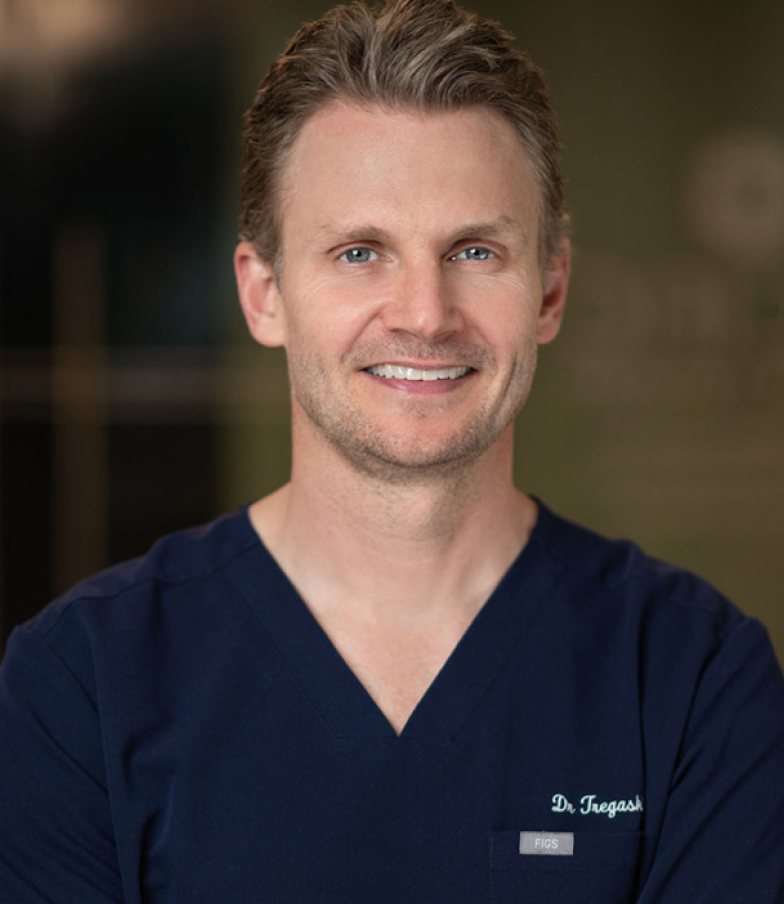
DR. ASHLEY TREGASKISS
COSMETIC, PLASTIC, AND RECONSTRUCTIVE SURGEON | BLOG
Dr. Ashley Tregaskiss is a board-certified plastic surgeon in Vancouver with over 20 years of experience and a practice increasingly dedicated to advanced facial and neck rejuvenation.
Following a decade at Vancouver General Hospital treating complex craniofacial trauma and head and neck conditions, he transitioned fully into private practice in 2024. This background provides a level of anatomical expertise and surgical precision that directly informs his aesthetic work.
Dr. Tregaskiss specializes in facelift and neck lift surgery, eyelid rejuvenation, facial fat transfer, and laser-based skin rejuvenation. He has particular expertise in combining facial surgery with laser treatments to enhance skin quality and achieve more refined, natural results. His approach is defined by careful planning, technical precision, and a commitment to outcomes that are balanced, elegant, and undetectable.